

How to Lab-Test THC: A Practical, No-Nonsense Guide
If you grow, manufacture, or sell cannabis products, you’ve probably been told to “get it lab tested.” That short phrase hides a lot of moving parts: choosing a method, preparing representative samples, documenting chain of custody, understanding the certificate of analysis (COA), and making decisions based on uncertainty and detection limits. This guide breaks down how to lab-test THC from start to finish so you can send in a sample with confidence and interpret the results like a pro.
What “THC testing” actually measures
Most cannabis flower contains THCA (the acidic precursor) and a smaller amount of Δ⁹-THC (the active, decarboxylated form). Accurate potency testing reports each separately and often includes a “Total THC” value calculated for labeling and regulatory purposes.
- THCA is converted to THC by heat or time. Because one carbon dioxide (CO₂) molecule is lost during decarboxylation, labs apply a molecular weight correction when estimating total THC from THCA.Common formula:Total THC (%) = (Δ⁹-THC %) + (THCA % × 0.877)The 0.877 factor accounts for CO₂ loss.
- Other cannabinoids (CBD, CBDA, CBG, etc.) may be tested at the same time. Terpenes, residual solvents, pesticides, heavy metals, moisture and water activity, and microbial contaminants are separate assays.
Knowing which numbers should appear on your COA helps you verify that the lab measured what you intended to purchase or release.
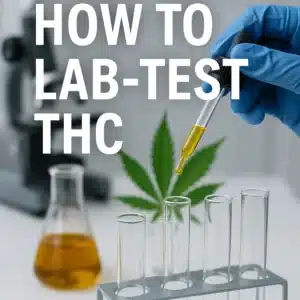
THC potency testing begins with careful sample handling and clean lab technique.
The two dominant lab methods for THC
1) High-Performance Liquid Chromatography (HPLC)
Best for: flower, pre-rolls, edibles, tinctures, capsules, topicals, and most concentrates.
- Measures cannabinoids in their native state (no heat), so THCA and THC are separated and quantified directly.
- Typical detectors: UV/Vis DAD (diode array) or MS (mass spectrometry).
- Widely adopted because it avoids decarboxylation inside the instrument.
2) Gas Chromatography (GC, usually GC-FID or GC-MS)
Best for: certain extracts and research applications; less common for compliance potency today.
- The injection port is heated, which decarboxylates THCA into THC. That means GC generally reports total THC directly, not separate THCA and THC values, unless the lab uses chemical derivatization to preserve acids (more complex).
- Excellent for residual solvent testing and detailed profiling by GC-MS, but for potency, HPLC is now the standard in most jurisdictions.
If your products are regulated, your compliance rules will likely specify HPLC potency and a validated method. For R&D or internal quality checks, both can be appropriate-just know what the numbers represent.
Step 1: Choose an accredited laboratory
Look for ISO/IEC 17025 accreditation for the specific scope of testing (cannabinoid potency). Accreditation doesn’t guarantee perfection, but it signals that the lab’s method is validated, instruments are calibrated, chemists are trained, and quality controls are routine.
When vetting a lab, ask for:
- Scope of accreditation showing cannabinoid potency (and any other assays you’ll need).
- Method summary (HPLC vs. GC, how they handle THCA/THC).
- Turnaround time and reporting units (%, mg/g, mg/unit, moisture-corrected or “as-received”).
- QC practices: use of calibration curves, system suitability checks, blanks, matrix spikes, and certified reference materials.
- Inter-laboratory proficiency testing participation and recent performance.
Build a relationship with your lab. A five-minute call can prevent five headaches later.
Step 2: Plan sampling that actually represents your batch
Sampling errors are the #1 reason products “fail” on paper. Cannabis is heterogeneous-big buds and small buds, trichome density differences, uneven infusion in edibles-so the small portion you send must represent the whole.
Flower and pre-rolls
- Batch definition: Set your lot size (e.g., a harvest lot or production run).
- Random sampling: Pull from multiple containers and positions (top, middle, bottom).
- Homogenize: Break up, mix, and grind gently to a uniform particle size without heating the material.
Concentrates
- Warm slightly (if safe) to make viscous extracts mixable, then stir to achieve uniformity before sub-sampling.
Edibles and beverages
- For bars or gummies, select multiple units across the batch and blend to a uniform slurry.
- For beverages, invert and mix thoroughly.
Topicals and tinctures
- Shake and stir. Oil-based systems can stratify; homogeneity matters.
Use clean tools, label everything, and document chain of custody: who collected the sample, when, from which batch/lot, the weight/volume, and intended tests.
Step 3: Package and ship samples correctly
- Use clean, inert containers (glass or appropriate HDPE) with tight lids. Avoid containers that can leach or absorb cannabinoids.
- Keep flower cool and in the dark to minimize degradation; for infused products, follow manufacturer and lab guidance.
- Fill out the lab’s submission form carefully: product matrix, requested assays (potency, terpenes, etc.), and your labeling needs (e.g., moisture-corrected percentages).
- Include unique sample IDs that match your internal batch records.
- Maintain a chain-of-custody form from collection to receipt at the lab.
What happens inside the lab (simplified)
- Sample intake & loggingThe lab confirms chain of custody, assigns an internal ID, and stores the sample under controlled conditions.
- HomogenizationEven if you homogenized, the lab will grind or mix again to ensure uniformity. Moisture may be measured to allow dry-weight correction.
- ExtractionA measured amount of sample (e.g., 100 mg of flower or a known mass/volume of extract) is placed in a solvent-often methanol, acetonitrile, or a mixture with buffer-to dissolve cannabinoids. The mixture is vortexed, sonicated, or shaken.
- Dilution & cleanupBecause concentrates can be extremely potent, extracts are diluted to bring cannabinoid concentrations into the instrument’s calibration range. The sample may be filtered (0.22-0.45 μm syringe filter) to protect the column.
- Chromatography
- HPLC: The extract passes through a C18 column. A gradient of solvents (water + acid modifier and acetonitrile or methanol) separates THCA from Δ⁹-THC and other cannabinoids. UV absorbance at ~220-230 nm (and/or MS) measures each peak.
- GC: A hot injector vaporizes the sample; analytes travel through a capillary column and are detected by FID or MS.
- QuantitationSignals are compared to a calibration curve derived from certified reference standards. Labs may use internal standards to correct for variation during extraction and analysis.
- Quality control checksEvery run should include:
- Blank (solvent only) to confirm no carry-over.
- Calibration verification standard to ensure the curve is accurate mid-run.
- Matrix spike and duplicate to evaluate recovery and precision in the actual product matrix.
- Control charts and system suitability to flag drift or column issues.
- Reporting & reviewResults are compiled into a COA with cannabinoid values, method, units, detection limits, analyst and reviewer signatures, and whether values were moisture-corrected. Good labs include measurement uncertainty, which tells you the range around a reported number where the true value likely falls.
Reading a COA without guessing
A solid potency COA will show:
- THCA (% or mg/g)
- Δ⁹-THC (% or mg/g)
- Total THC (with the conversion factor listed)
- Moisture (%) or water activity (sometimes separate)
- Other cannabinoids measured in the same run (CBD/CBDA, CBG/CBGA, etc.)
- Units for finished goods (mg per piece, mL, or serving) when you supply serving size information
- Method type (HPLC-UV, HPLC-MS, GC-FID, etc.)
- LOD/LOQ (limits of detection and quantitation)
- Uncertainty (e.g., ±0.5% absolute)
- Accreditation & signature fields
Moisture correction matters. A flower at 8% moisture will show higher “dry-weight” cannabinoid percentages than the exact same flower at 12% moisture. Decide with your lab whether you need “as received” or “dry-weight” values for your labels and remain consistent across batches.
Avoid the common pitfalls
Non-representative samplingMix thoroughly and draw from multiple containers. For edibles, don’t submit a single gummy-blend many.
Heat and lightTHCA decarboxylates and THC oxidizes to CBN over time, especially with heat and UV. Store and ship cool and dark.
Matrix effectsChocolate, gummies, ointments, and distillates all behave differently during extraction. Validated methods handle these matrices; shortcuts can skew potency high or low.
Over-dilution or under-dilutionIf the lab dilutes too much, low-level cannabinoids may drop below LOQ; too little, and the detector saturates. Good labs perform preliminary range checks and adjust.
Chasing exact matchesTwo good labs using validated methods can still report slightly different numbers because of uncertainty, moisture, and sampling. Focus on consistency and trend, not identical decimals.
THC testing for different product types
Flower and trimHPLC with moisture correction is standard. Water activity may be required for microbial safety evaluation.
Concentrates (rosin, shatter, wax, crumble, distillate)Potency can exceed 80-95% total cannabinoids, requiring large dilutions. Ask your lab to report mg/g in addition to %; it’s often easier to understand mass per gram for blending and formulation.
Edibles and beveragesLabs need serving size and total pack information to report mg per serving and mg per package. For high-fat matrices (chocolate) or acidic matrices (gummies), validated extraction is critical.
Tinctures & topicalsOil or alcohol base changes extraction and dilution choices. Labs may request viscosity or density information to convert % to mg/mL accurately.
In-house screens vs. accredited lab testing
Color-change test kits and portable spectrometers can provide rough estimates, but they cannot replace an accredited potency result. They’re useful for R&D and process control (e.g., checking whether a blend is in the ballpark before sending to the lab). If you rely on them:
- Calibrate against multiple COAs from an accredited lab.
- Expect higher uncertainty and limited comparability across product types.
- Use them to reduce surprises, not to make label claims.
Validation, proficiency, and why they matter
A reliable lab doesn’t just run samples-it proves the method works in your product matrix. Key validation elements include:
- Accuracy/Recovery: How close results are to the true value (using spiked samples).
- Precision: Repeatability (same analyst, same day) and reproducibility (different days/analysts).
- Linearity: The calibration curve remains accurate over the full range (e.g., 0.1-1000 mg/L).
- LOD/LOQ: The smallest quantifiable level with acceptable precision.
- Robustness: Minor changes (e.g., column lot, temperature) don’t break the method.
Ask if your lab participates in inter-lab proficiency testing programs. Consistent, strong performance in blind studies builds trust that your numbers are not an outlier.
Cost, turnaround, and planning
Prices vary by region and volume, but as a rough guide:
- Potency only: Often the least expensive test and fastest turnaround (1-3 business days).
- Full compliance panel: Adds terpenes, residual solvents, pesticides, heavy metals, microbials, mycotoxins, moisture/water activity. Expect longer turnaround.
Build testing into your production calendar. Holding inventory while you wait on COAs is part of operating in a regulated space; planning prevents bottlenecks.
Working with your lab like a partner
- Share your goals. Tell the lab whether results are for R&D, label claims, or regulatory release.
- Standardize submission. Use the same container types, fill levels, and sample masses each time.
- Ask for method notes. If a COA changes format or numbers look off, request the batch QC summary (many labs will share at least a high-level view).
- Track trends. Keep your own spreadsheet of results, moisture, and units. If potency drifts over time, you’ll catch issues upstream (harvest timing, drying, infusion mixing).
Example potency workflow from start to finish
- Define the batch (e.g., “Sunset Sherbet, Harvest 2025-09-15, Lot SS-0915-A, 15 kg”).
- Randomly sample from at least 10 containers, combine ~50 g of flower, mix and grind.
- Sub-sample ~2-5 g into a labeled glass jar; complete chain-of-custody and submission form.
- Ship with cold packs if weather is hot; keep in the dark.
- Lab receives and logs; moisture measured; sample extracted and analyzed via HPLC-UV with a five-point calibration curve.
- QC passes (blanks clean; calibration verification within tolerance; spike recovery 98%; duplicate RSD 1.8%).
- COA issued showing: THCA 18.2%, Δ⁹-THC 1.0%, Total THC 17.0% (dry-weight), moisture 11.5%, uncertainty ±0.6% absolute.
- You review and approve for label claims (rounding consistent with your policy).
- Archive the COA and retain a reserve sample from the lot, sealed and dated, for any future questions.
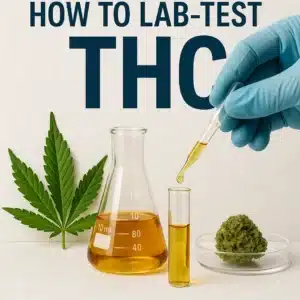
Preparing a homogenized sample is essential before running HPLC or GC analysis.
Frequently asked realities (not myths)
“Can I request the lab to report higher numbers?”No reputable lab will manipulate results. Potency inflation is a known industry issue; selecting a lab for “big numbers” risks recalls, fines, and loss of credibility. Accuracy beats hype.
“Why do my retests differ by 1-2%?”Normal. Moisture changes, sampling differences, and method uncertainty explain small shifts. Large swings suggest sampling or homogenization problems.
“Is total THC the only number that matters?”For psychoactive effect in combustion products, total THC is a useful indicator. For edibles and tinctures, mg per serving is more relevant. Many consumers also care about terpenes and minor cannabinoids; consider a broader panel for marketing and formulation insight.
The takeaways
- Pick an accredited lab with validated methods (HPLC for potency is common) and transparent QC.
- Sample smart. A well-mixed, representative aliquot is the difference between “accurate” and “misleading.”
- Understand your COA. Look for THCA, THC, total THC, moisture, LOQ/LOD, and uncertainty.
- Store and ship to prevent degradation.
- Treat your lab like a partner. Ask questions, compare trends, and make testing part of your process-not a last-minute chore.
When you understand how THC is measured-and where errors creep in-you’ll trust your numbers, label products with confidence, and build a reputation for consistency that outlasts any single harvest or production run.


Leave a comment
Your email address will not be published. Required fields are marked *
You must be logged in to post a comment.