

How to Make CBG
In the rapidly evolving landscape of cannabis and hemp, Cannabigerol (CBG) has emerged as one of the most sought-after compounds. Often hailed as the “Mother of All Cannabinoids” or the “Stem Cell of Cannabis,” CBG offers a unique profile of potential benefits, distinct from the sedative properties of CBD or the intoxicating effects of THC. However, if you have ever shopped for CBG products, you likely noticed they come with a higher price tag and a bit more mystique than their counterparts.
This scarcity is not an accident; it is a biological reality. Unlike THC or CBD, which the hemp plant produces in abundance naturally, CBG is fleeting. To produce it at a commercial scale requires a sophisticated blend of advanced genetics, precise agricultural timing, and high-tech laboratory fractionation.
“Making” CBG isn’t as simple as planting a seed and waiting for harvest. It involves battling the plant’s own biological programming. This comprehensive guide explores the complex journey of CBG production, from the genetic modification of seeds to the chromatographic separation in the lab.

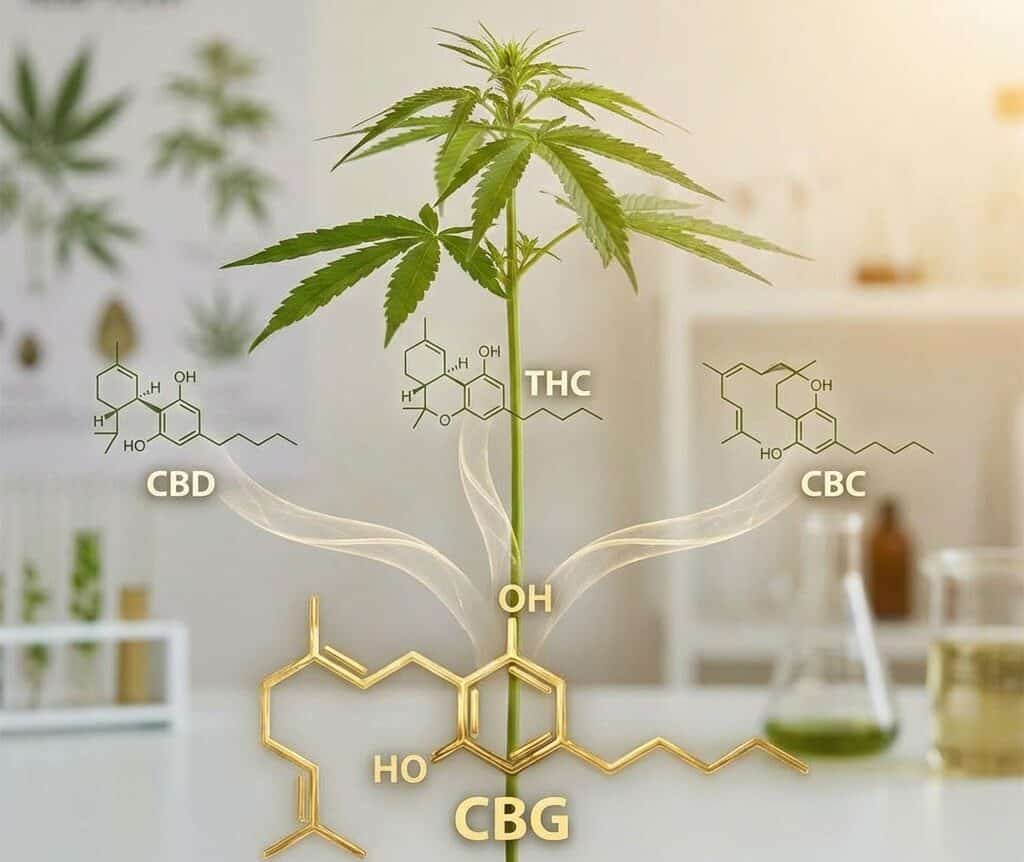
Bridging nature and science: High-CBG genetics provide the raw material, while advanced chromatography refines it into a usable product.
The Biological Barrier: Why CBG is Hard to “Make”
To understand how we make CBG, we first have to understand why the plant naturally destroys it.
In the cannabis plant, all cannabinoids begin their life as Cannabigerolic Acid (CBGa). This is the foundational precursor. As the plant grows and matures, it produces specific enzymes known as synthases. These enzymes are biologically programmed to grab the CBGa molecules and convert them into the “major” cannabinoids.
- THC-synthase converts CBGa into THCa.
- CBD-synthase converts CBGa into CBDa.
- CBC-synthase converts CBGa into CBCa.
By the time a standard hemp plant reaches full maturity (usually 8–12 weeks), almost all the initial CBGa has been converted. A typical harvest might contain 15% CBD but less than 1% CBG. Therefore, to “make” CBG, producers essentially have to stop time or break the plant’s internal machinery.
There are three primary methods used in the industry today to produce CBG:
- The Genetic Route (Selective Breeding)
- The Agricultural Route (Early Harvesting)
- The Synthetic Route (Biosynthesis)
Method 1: The Genetic Route (Selective Breeding)
This is currently the most effective and sustainable method for producing CBG-rich biomass. Instead of fighting the plant’s enzymes, breeders have developed strains that simply lack them.
Shutting Down the Assembly Line
Geneticists and botanists have spent years cross-breeding plants to identify phenotypes with a recessive gene that inhibits the production of CBD-synthase and THC-synthase. When these enzymes are absent or inactive, the plant produces CBGa as it grows, but the “conversion factory” is shut down. The CBGa accumulates in the trichomes because it has nowhere else to go.
The Rise of High-CBG Strains
Strains such as “White CBG,” “Jack Frost,” and “Stem Cell” are the result of this breeding. These plants can grow to full maturity while retaining high concentrations of CBG (often 15% or higher) and keeping THC levels near zero.
The Advantages:
- High Yield: Farmers can grow these plants to full size, maximizing biomass per acre.
- Compliance: Because conversion to THC is blocked genetically, these plants rarely exceed legal THC limits.
Method 2: The Agricultural Route (Early Harvesting)
Before geneticists perfected high-CBG strains, this was the primary way to extract the compound.
The Window of Opportunity
If you are growing a standard CBD-rich hemp strain, the plant will have its highest concentration of CBG roughly 6 to 8 weeks into the flowering cycle.
Farmers using this method will test their crop daily. The moment the CBG levels peak—they chop the entire crop.
The Trade-Offs
- Low Biomass: Early harvest reduces total yield.
- Low Oil Content: Resin glands are underdeveloped.
- The “Mids” Problem: Flower lacks terpene maturity.
Method 3: Extraction and Isolation (The Laboratory Phase)
Whether the biomass comes from genetics or early harvesting, it must undergo extraction involving Chromatography.
Step A: Crude Extraction
- CO2 Extraction: Uses pressurized carbon dioxide.
- Cryogenic Ethanol: Uses sub-zero ethanol soaking.
Step B: Winterization and Filtration
Removes fats and waxes through freezing and filtration.
Step C: Decarboxylation (Activation)
Up to this point, the molecule is CBGa. Heating converts it to CBG.
- The Process: Heat to roughly 220°F (105°C).
- The Reaction: CO2 is released, activating the molecule.
Step D: Distillation
Separates cannabinoids using vacuum and heat.
The CBG Challenge: CBG has a similar boiling point to CBD, making separation difficult.
Step E: Chromatography
Pure isolate requires Flash Chromatography.
- How it works: Molecules separate by polarity.
- The Separation: Fractions are collected individually.
- Isolation: Solvent evaporates, leaving pure CBG.
Method 4: Biosynthesis (The Future of CBG)
Known as Cellular Agriculture or Biosynthesis.
- Feed the Yeast: Sugar fuels production.
- Fermentation: Yeast produces CBGa.
- Harvest: Extract from solution.
Why this matters:
- Consistency: No environmental variability.
- Purity: Pharmaceutical-grade output.
- Scalability: Lower cost at scale.
Can You Make CBG at Home?
What you CAN do:
- Smoke it: Enjoy directly.
- Make Rosin: Use heat press.
- Make Butter/Oil: Infuse for edibles.
What you CANNOT do:
You cannot isolate pure CBG without professional chromatography equipment.
Conclusion: The Cost of Purity
When you hold a bottle of CBG oil, you are holding the result of significant scientific effort.
This explains the price difference between CBG and CBD. As genetics and biosynthesis improve, CBG will likely become more accessible worldwide.




Leave a comment
Your email address will not be published. Required fields are marked *
You must be logged in to post a comment.